AI feed bunk monitoring from the trail cam you already own See Every Hour Your Bunk Sat Empty, Even at 3 AM
Upload a week or two of trail-camera photos from your feed alley. FeedBunk AI shows when the bunk ran empty, when feed arrived, and whether push-ups kept up, with the photo behind every event. New in beta: how your cows respond at the bunk.
Free during the beta. No new hardware.
What’s in Your Report
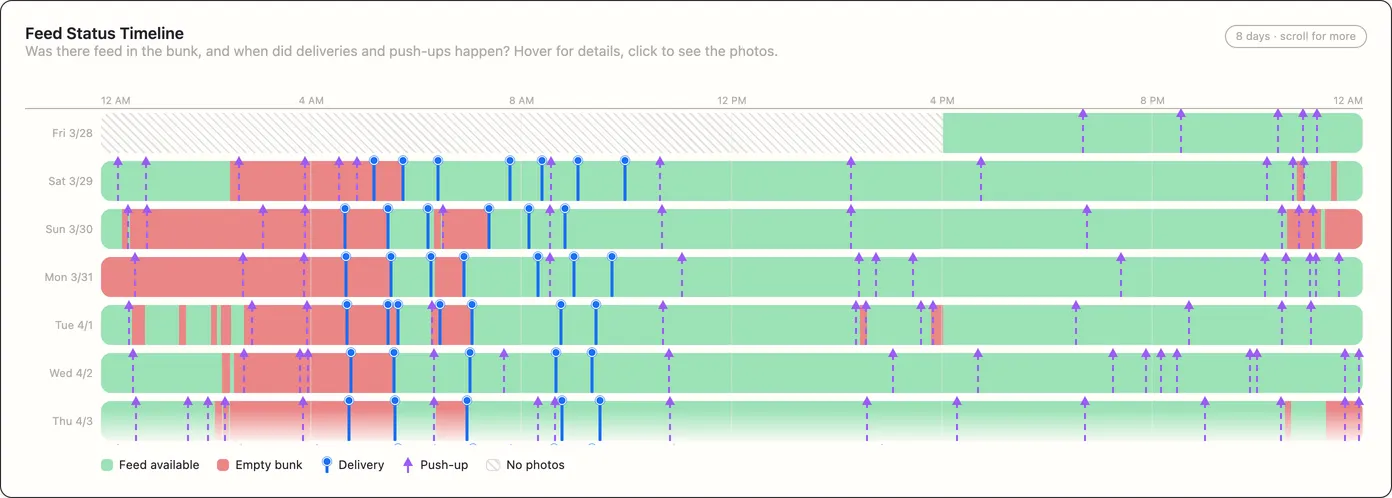
Every screen on this page comes from a real FeedBunk AI report, with the farm anonymized. These first screens cover 8 days at one bunk: 20,281 trail-camera photos.
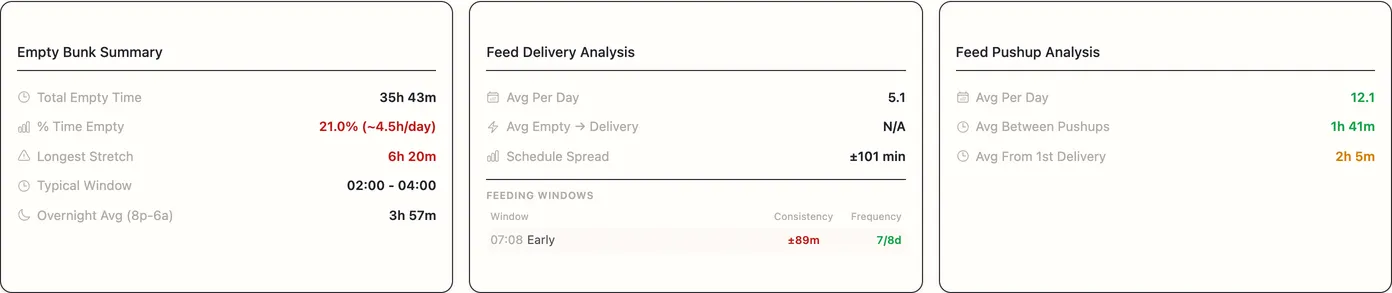
How long was the bunk empty, and when?
The summary cards lead with the numbers that matter: total empty time, the longest single stretch, the hours it usually happens, and an overnight average from 8 PM to 6 AM, next to deliveries and push-ups per day. On this farm the bunk sat empty 21.0% of the time, about 4.5 hours a day, most often between 2 and 4 AM.
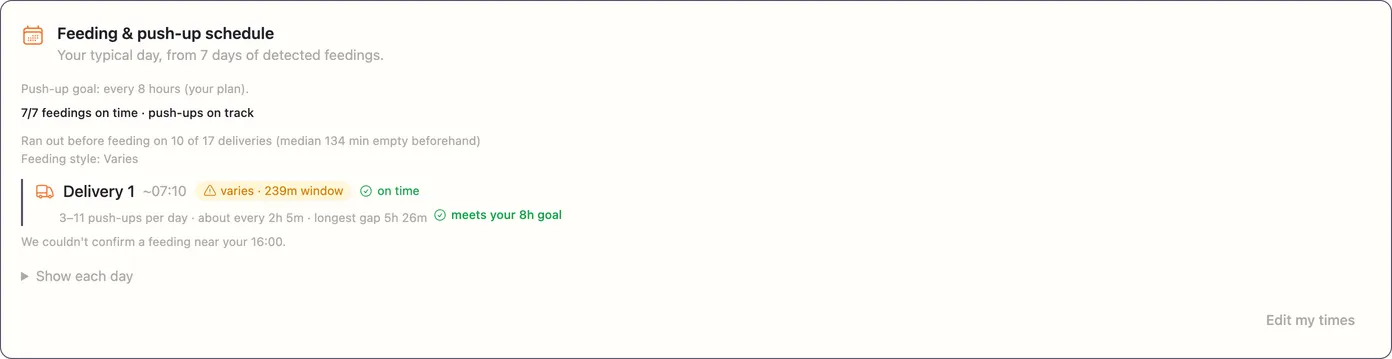
Are feedings on schedule, and did the bunk run out first?
FeedBunk AI finds your usual feeding times, checks each day against them, and shows how often the bunk had already run out before feed arrived. Here, feedings came on time against the farm’s plan, but the bunk was already empty before 10 of 17 feedings, for a median of 2 hours 14 minutes. This card checks push-ups against a goal you set (this farm planned one every 8 hours); the chart below holds every delivery to a stricter 2-hour window.
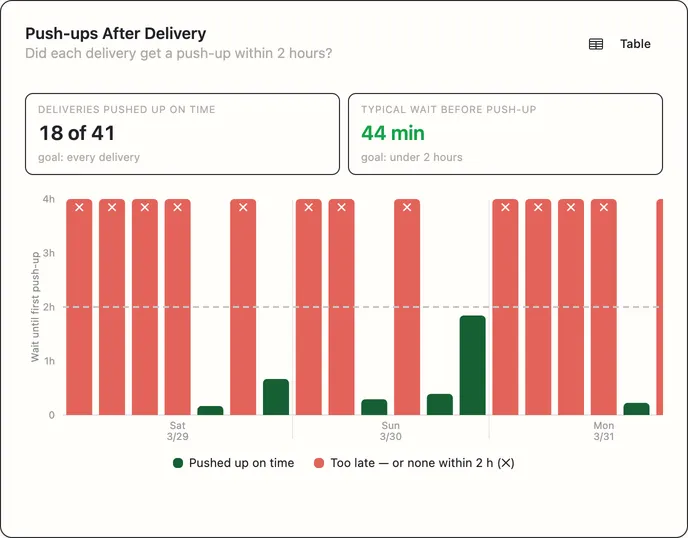
Did each delivery get pushed up within 2 hours?
Cows eat hardest right after fresh feed lands, and that is when they push it out of reach. One bar for every load the camera saw (41 over 8 days, since one feeding can take several loads) shows whether a push-up followed in time. This farm got there on 18 of 41.
Check any number against the photo
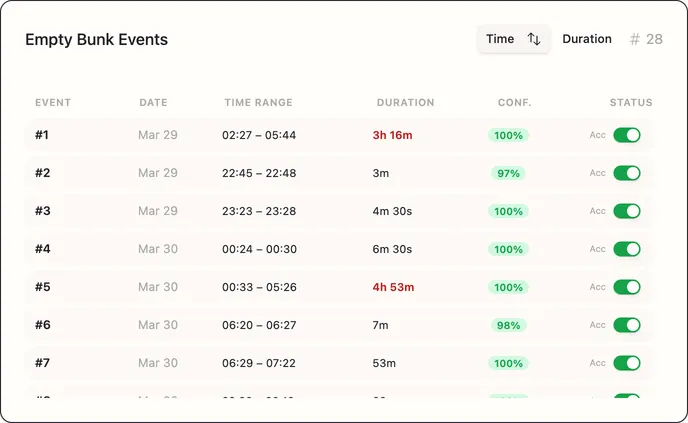
Every empty stretch, delivery, and push-up is listed with its time, how long it lasted, and a confidence score. Open the photo to see it for yourself. Reject an event that’s wrong and the report recalculates.
Three goals your report checks
Each is graded green, amber, or red. The 3-hour limit follows Penn State Extension and Miner Institute guidance; the 2-hour push-up window and the schedule check are FeedBunk AI rules of thumb.
Longest time without feed
Past about three hours, cows come back to the bunk hungry enough to slug feed: too much, too fast, and rumen pH drops.
Push-up after every delivery
Fresh feed is when cows eat hardest and push it furthest out of reach. A push-up in the first two hours keeps it in front of them.
Feeding on schedule
The report finds your usual feeding times and shows how far each day drifts from them, so a late feeding stands out.
Do the math for your herd: if better feed access is worth even 1 lb of milk per cow per day, a 500-cow herd at $20/cwt gains $100 a day. That’s an illustration, not a promise. Plug in your own numbers.
New in your report Beta
What Your Cows Are Doing at the Bunk
FeedBunk AI now counts the cows in the camera’s view through the day, so you can see whether they come when feed arrives and how long they stand at an empty bunk. These screens come from a second farm’s September week. Counts are cow heads in one camera’s view, not the whole pen.
Three verdicts, and when your cows are eating
Do deliveries draw cows to the bunk? Do push-ups? How many cow-hours were spent at an empty bunk? Each question gets Good, Watch, or Act, with what to check first. Below it, one row per day shows how many cows are at the bunk hour by hour, with deliveries, push-ups, and empty periods on the same timeline. On this farm, 83.2 cow-hours at an empty bunk over 4.8 days earned an Act. That’s about 17 a day, roughly the same as 17 cows each standing an hour at an empty bunk.
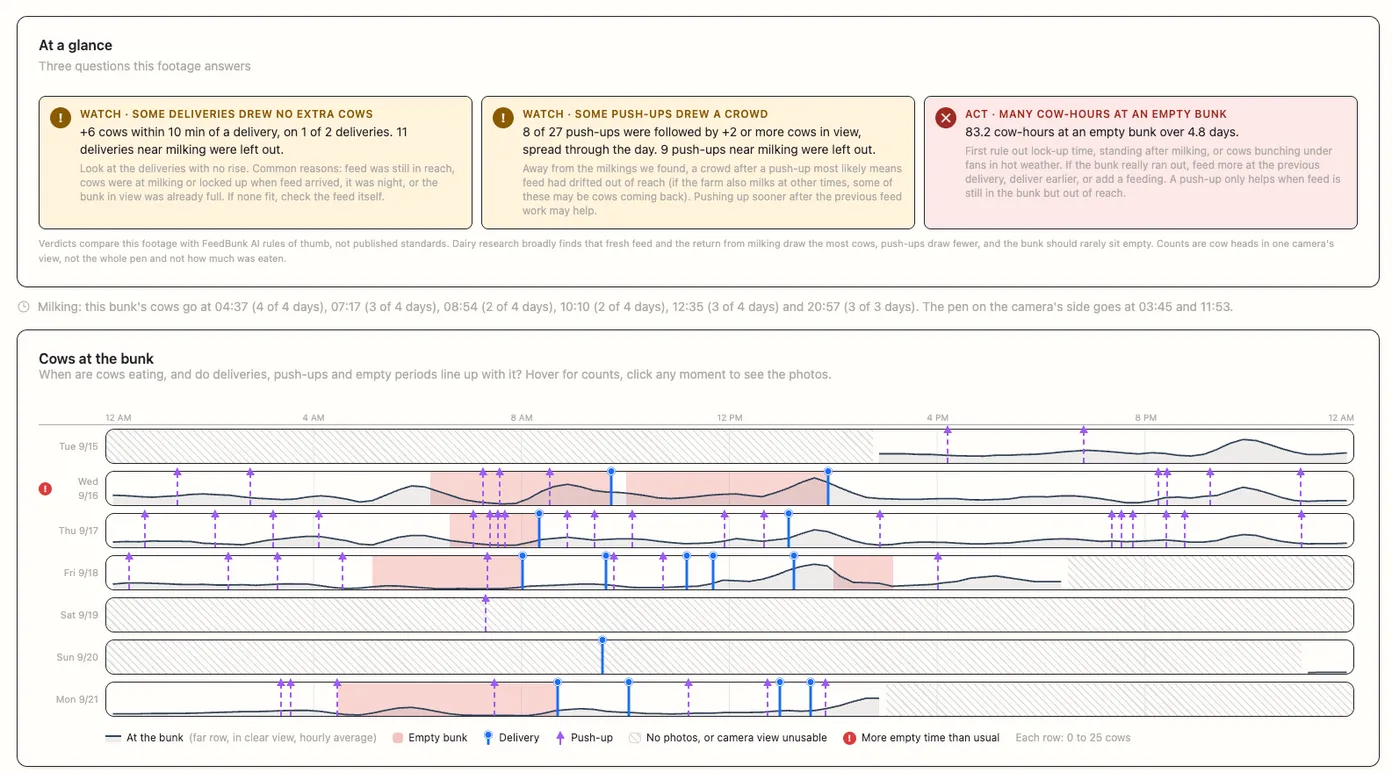
Do cows come when feed arrives, and how long do they wait at an empty bunk?
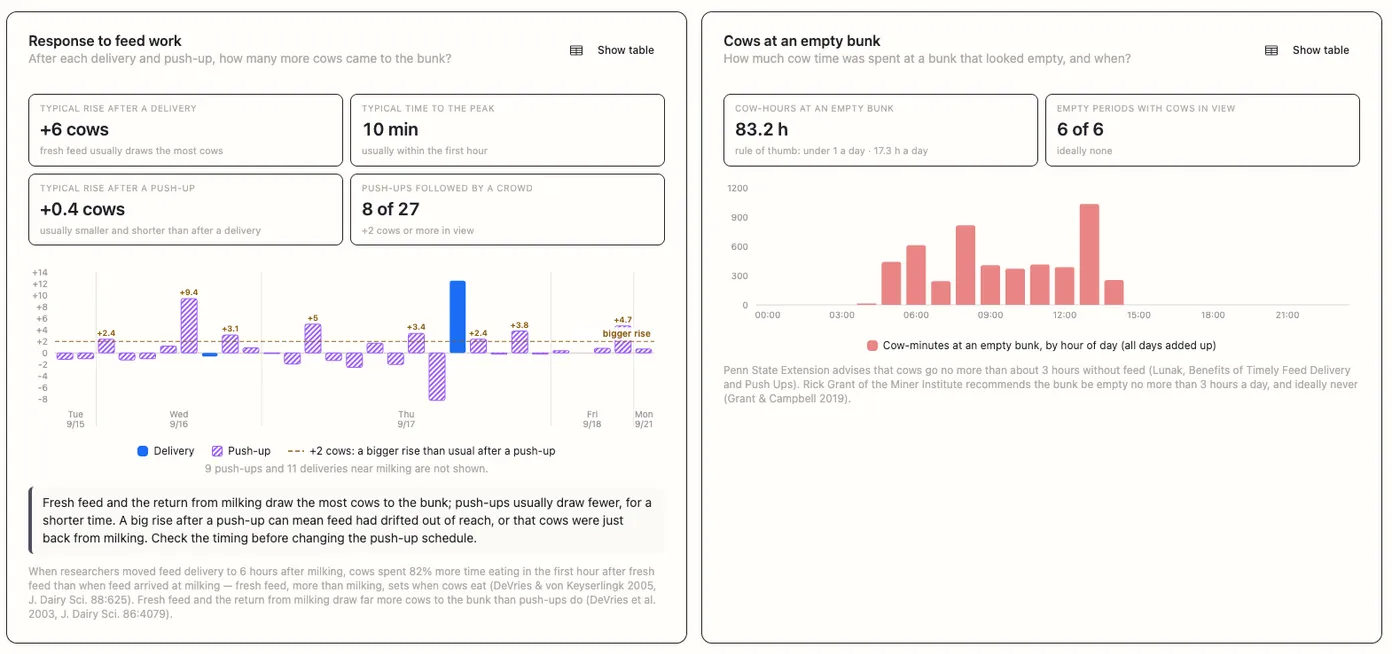
After every delivery and push-up, the report measures how many more cows came to the bunk and how fast. Here a delivery typically drew 6 more cows within 10 minutes, while a push-up drew less than one. Cow-hours at an empty bunk are added up by hour of day, so you can see which feeding to move earlier or make bigger. Verdicts use FeedBunk AI rules of thumb, with the dairy research they draw on cited under each chart.
How Feed Bunk Monitoring Works
From SD card to report, with the trail camera you already have.

Set up the camera
Any trail camera with a time-lapse mode, set to a photo every 10 seconds and aimed down the feed alley. Leave it running for a week or two.

Upload the photos
Pull the SD card. The free FeedBunk AI Compressor app for Mac and Windows shrinks the photos on your computer and uploads them, picking up where it left off if the connection drops.

Read your report
Open the report in the app, check events against their photos, and download a PDF to share with your nutritionist or consultant.
Built for the People Who Manage the Bunk
One report, read three ways.
Owners and herd managers
See whether the night push-ups happened and how long the bunk sat empty before morning feed, night by night, without standing in the barn to watch.
Nutritionists
Know how many hours a day feed was actually in front of the cows, and whether they came to eat when it arrived, before you change the ration over an intake or butterfat dip. Bring the PDF report to your next farm visit.
Consultants and advisors
Point to the exact day, hour, and photo behind a recommendation, so the conversation is about what happened at the bunk, not what someone remembers.
Common Questions About AI Feed Bunk Monitoring
If your question isn't here, email [email protected] and we'll get back to you.
What is AI feed bunk monitoring?
AI feed bunk monitoring is automated analysis of camera photos at the feed bunk to find feed deliveries, push-ups, and empty-bunk periods. FeedBunk AI analyzes the trail-camera photos you take at your own bunk, so there are no new cameras or sensors to install.
Do I need a new feed bunk camera to use FeedBunk AI?
No. Any trail camera with a time-lapse mode works, set to take a photo every 10 seconds and aimed down the feed alley. Pull the SD card, upload the photos with the free FeedBunk AI Compressor app or in your browser, and your report is built from them. The Help Center covers mounting, aiming, and camera settings.
What does the FeedBunk AI report show?
How long the bunk sat empty (total, longest stretch, and overnight from 8 PM to 6 AM), every feed delivery and push-up with its time, how consistent your feeding times are from day to day, how often the bunk ran out before a feeding, and how soon each delivery got pushed up. In beta, it also counts the cows at the bunk through the day: how they respond to deliveries and push-ups, and how much time they spend at an empty bunk. Feed results are graded against two goals: no more than about three hours without feed, a limit that follows Penn State Extension and Miner Institute guidance, and a push-up within two hours of each delivery, a FeedBunk AI rule of thumb.
How accurate is automated bunk reading?
Every event in the report shows its time, a confidence score, and the photo it came from, so you can check any number yourself. If an event is wrong, reject it and refresh the report to recalculate. The same check runs on every photo, including overnight when nobody is in the barn.
Can I share the report with my nutritionist or consultant?
Yes. Download the report as a PDF and send it on. The PDF carries the summary cards and charts; the day-by-day timeline and the event photos stay in the online report.
How much does feed bunk monitoring software cost?
FeedBunk AI is currently in beta and pricing has not been announced yet. Joining the beta is free, and beta farms will hear the details first.
I already have an account. How do I sign in?
Use Sign in at the top of this page, or go straight to app.feedbunkai.com/login. The same email and password also sign you in to the FeedBunk AI Compressor app.
What does feed bunk management actually involve on a dairy?
Feed bunk management is the operational discipline of keeping feed available, fresh, and accessible to cows. It covers delivery cadence, push-up frequency, refusal targets, bunk scoring, and slug-feeding prevention. The Aurox.io guide on feed bunk management covers the full workflow and how AI fits in.
More on bunk operations and ration consistency: the Aurox.io feed bunk management guide. What a bunk score measures: bunk score, defined.
Free During the Beta
Sign up and upload your first batch today. Beta farms get:
Want help setting up your camera?
Most farms sign up and upload on their own. If you’d rather we walk you through camera placement and your first upload, leave your details and we’ll get in touch.