An empty bunk means cows that want to eat and cannot. This card tells you how much of that happened, when, and how bad the worst of it was.
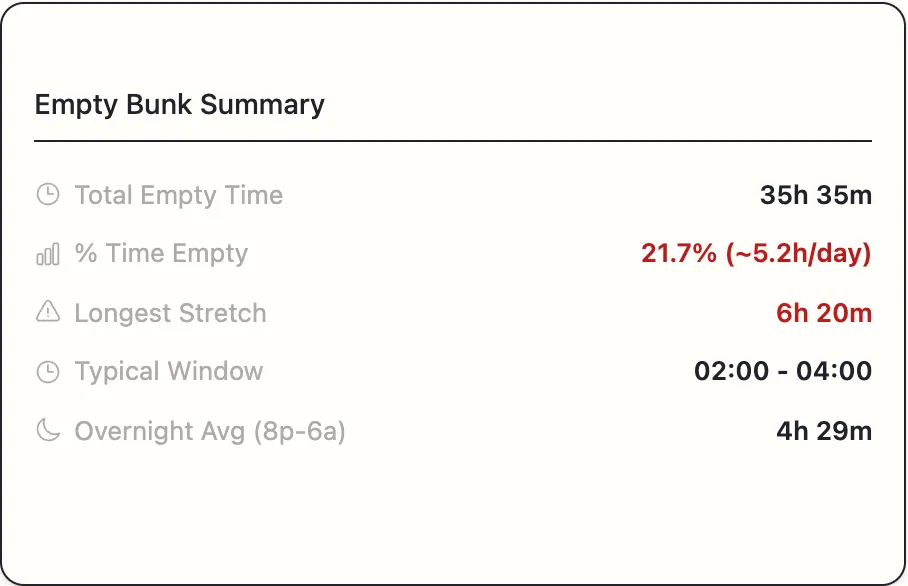
Total Empty Time
The total across the whole recorded period — for example 14h 20m over seven days.
On its own this is hard to judge, because it depends entirely on how long you recorded. Use it as a raw total and read the percentage below for context.
% Time Empty
The share of recorded time the bunk was empty, with a per-day figure alongside it: 3.4% (~0.8h/day).
| Colour | Value |
|---|---|
| Green | 4.2% or less — under about an hour a day |
| Amber | 4.2% to 12.5% — up to about three hours a day |
| Red | Above 12.5% — more than three hours a day |
Why the percentage and the hours do not multiply out neatly: the percentage is measured against the time your camera was actually recording, which may be less than a full 24 hours a day if the camera stopped or the card filled. The hours-per-day figure is worked out separately, across the days that actually have footage. They are both right; they are answering slightly different questions.
Longest Stretch
The single longest continuous period the bunk sat empty — or None if it never did.
| Colour | Value |
|---|---|
| Green | 2 hours or less |
| Amber | 2 to 3 hours |
| Red | Over 3 hours |
Three hours is the number that matters. Beyond that, cows show a marked increase in eating motivation, which drives slug feeding when feed finally arrives — they eat too much, too fast, and rumen pH drops.
A red Longest Stretch with a green % Time Empty is a common and useful pattern: your overall availability is fine, but one specific gap is hurting you. Find it on the Feed Status Timeline and you usually find one identifiable cause — a late Sunday delivery, a missed overnight push-up.
Typical Window
The time of day the bunk is usually empty, for example 03:10 - 05:25, or No clear window found if there is no pattern.
A clear window is good news, because it is actionable. Empty every morning between three and five means feed is running out before the morning delivery — either the evening amount is short or the delivery is too late. No clear window means the empties are scattered, which usually points at push-up timing rather than delivery volume.
Overnight Avg (8p-6a)
Average empty time per day falling between 8pm and 6am. This row only appears if there is any.
Overnight is where FeedBunk AI earns its keep, because it is the stretch nobody is in the barn to see. Cows do eat overnight, and a bunk that empties at midnight and stays empty until the morning feed is a real loss that manual bunk scoring will never catch — by the time anyone looks, the morning delivery has already covered it.
Putting it together
- Everything green — feed availability is not your constraint.
- Long stretches, low total — a specific gap, usually at a predictable time. The most fixable pattern there is.
- High total, short stretches — feed runs out often but gets caught quickly. Usually a push-up frequency problem rather than a delivery one. See Feed Pushup Analysis.
- High overnight — look at the timing and size of your last delivery of the day.
Check the events themselves
Before you change your routine, click a few rows in the Empty Bunk Events list and look at the photos. If a “empty” event turns out to be a dark night shot where nothing is visible, or a tractor parked across the bunk, reject it — the numbers recalculate without it. See Event lists and event photos.