This card turns the raw event counts into a description of your day, in the same words you would use yourself.
What it shows depends on whether you have told us your intended feeding times — see Tell us your feeding schedule.
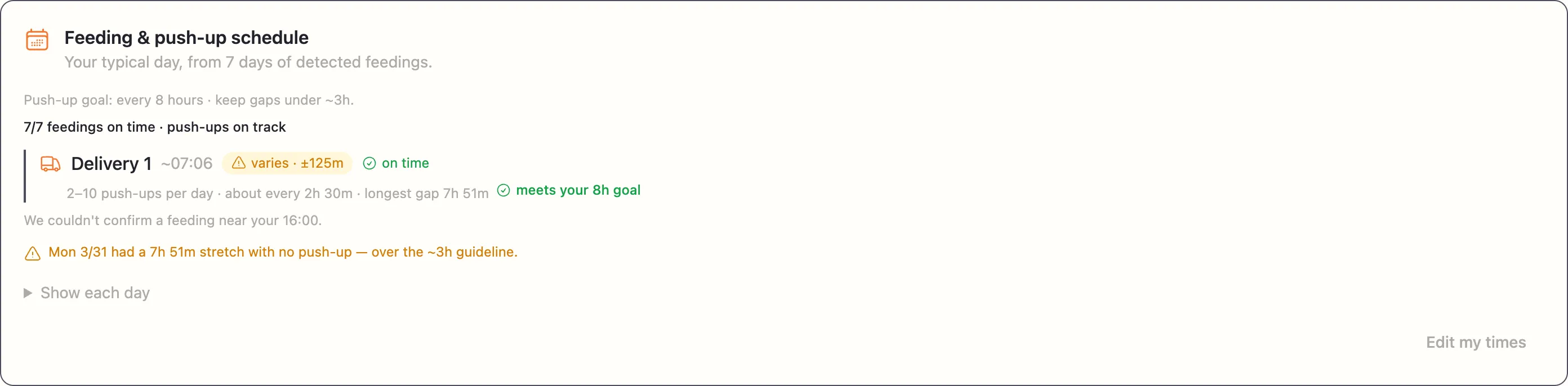
Your typical day
When we have detected enough deliveries, the card leads with a headline like:
12/14 feedings on time · push-ups on track
or push-ups behind your 4h goal.
Below it is a numbered timeline of your day:
🚚 Delivery 1 ~06:10 · consistent · ±12m · 6/7 days — on time 3–5 push-ups per day · about every 1h 45m · longest gap 3h 10m — meets your 4h goal
Each delivery gets a consistency chip — same time daily, consistent · ±12m, or varies · ±40m — and, if you gave us target times, a grade: on time, or something like ~35m later than your 06:00.
Under each delivery you get the push-up service that followed it: how many, how often, and the longest gap, measured against your stated goal.
Where we could not match one of your stated times to anything we detected, it says so plainly:
We couldn’t confirm a feeding near your 18:00.
That is worth investigating rather than dismissing. Either the feeding did not happen on the days recorded, or it happened and was not detected — and the event list will tell you which.
Welfare flags
Individual bad days get called out by name:
⚠ Tue 7/8 had a 4h 20m stretch with no push-up — over the ~3h guideline.
Three hours is the guideline because that is where cows show a marked jump in eating motivation once feed comes back within reach.
Show each day
A collapsible Show each day section lists every delivery and push-up with its time, day by day. Use it when a summary number surprises you and you want to see which day is responsible.
The comparison view
If you have saved feeding times but we could not build a typical-day picture, the card shows a comparison instead: your time chips, three tiles — On time, Missed, Extra — and a Day-by-day breakdown.
Extra is not a criticism. It means feed arrived at times you did not list, which is often perfectly deliberate.
Push-up cadence
Where there is not enough structure for the full timeline, you still get the cadence line:
Push-ups: you aim for every 4 hours · we detect about one every 2h 10m
and, when relevant:
Longest stretch without a detected push-up: about 4h 30m. That’s longer than your target — cows shouldn’t go more than ~3 hours without feed pushed back within reach.
Improving the grade
At the bottom of the card is Improve schedule results? — or Edit my times if you have already set them. It opens the same two questions as setup: your usual delivery times, and how often feed gets pushed up.
Change them, click Save my schedule, and the report re-grades immediately against the new times. See Edit your feeding times.
If the grade looks unfair
Before adjusting your routine, check the grade is being measured against real detections. A “missed” feeding that actually happened is a detection problem, not a management one — and tagging your feed vehicles is the fix. Correct the events first, refresh, then read the grade.